
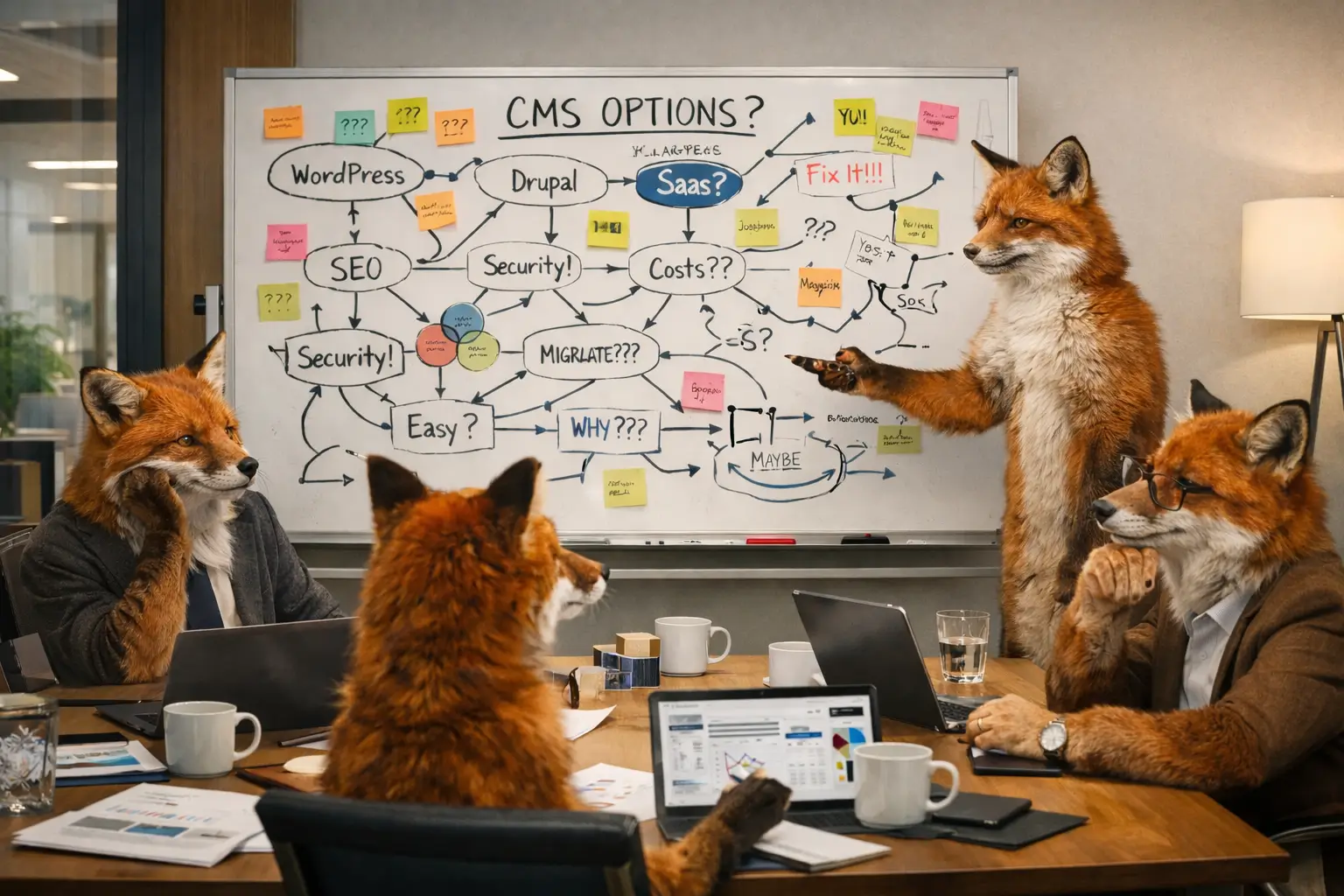
It’s a question as old as the agency world itself, usually asked right in the middle of a high-stakes client meeting: “So, should we build the new site on WordPress or Drupal?” When that question hits the table, it’s a bit like asking whether the client should buy a reliable, stylish SUV or a heavy-duty industrial transport truck. Both will get them where they’re going, but one is much better at hauling three tons of complex data through a blizzard, while the other is perfect for getting a brand noticed on the high street.
In the world of open-source platforms, these two are the undisputed kings. But here’s the thing we always tell our agency partners: they aren’t the only names on the map. At Digiteam, we know these open-source giants inside and out, but we’re just as comfortable in the world of high-end SaaS and commercially licensed enterprise platforms. Let’s settle the open-source debate once and for all, and then we’ll show you how to look at the rest of the landscape.
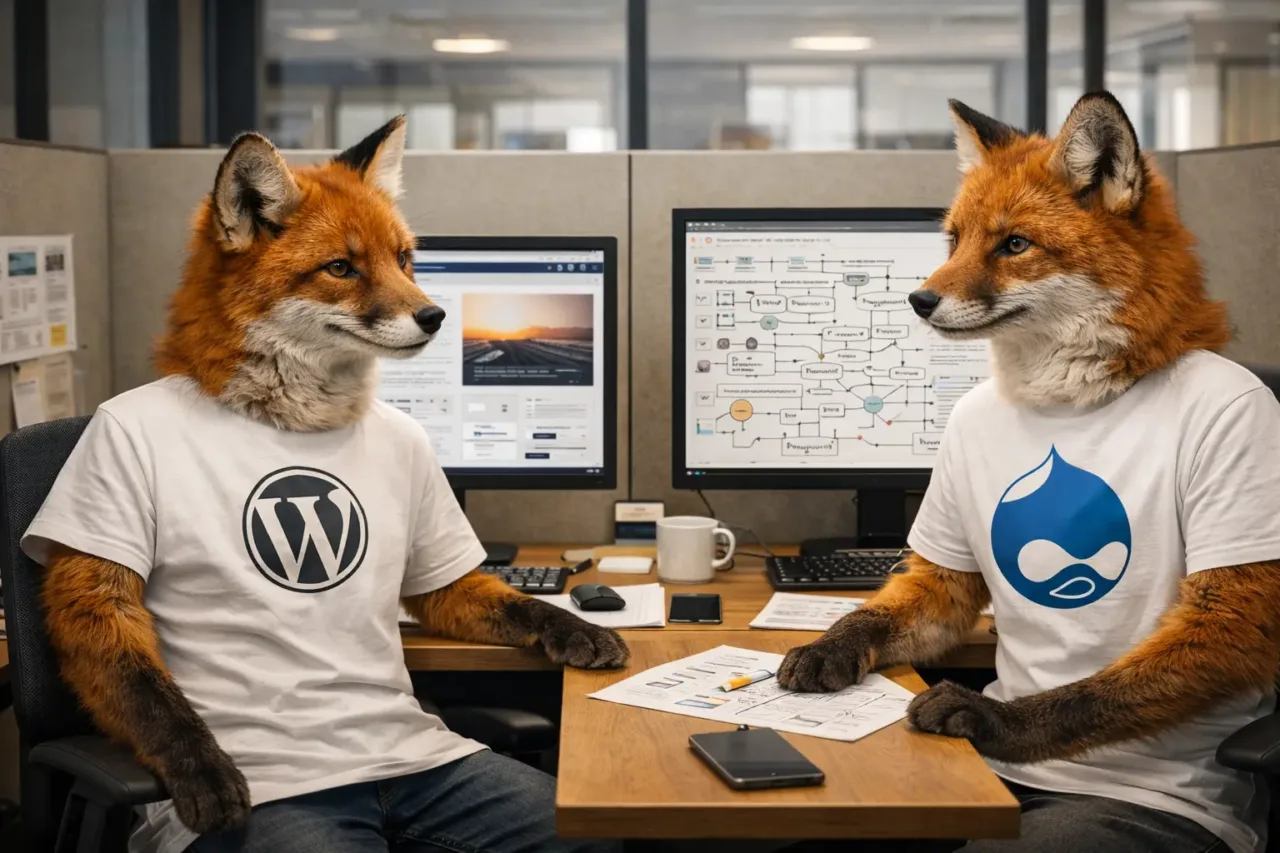
The Big Two
Why We Love the Open-Source Heavyweights
When a client asks for an “open-source” solution, they are usually looking for two things: flexibility and freedom from recurring licensing fees. Because the code is open to the public, these platforms have massive communities behind them, which means they are constantly evolving.
To give you an idea of just how big this world is, consider the latest data for 2026. WordPress continues to dominate the digital landscape, powering 42.5% of the entire internet. If you look specifically at websites that use a CMS, WordPress holds nearly 60% of the market. To put that in perspective, its nearest competitor, Shopify, sits at just about 5%.
It is, quite literally, the “people’s champion.” But that doesn’t mean it’s the only choice.
WordPress: The World’s Favourite Content Engine
We’ve come a long way from the days when WordPress was just a “blogging tool.” Today, it’s a versatile powerhouse. The reason we recommend it so often to our creative agency partners is simple: it’s fast and friendly.
The user interface is so intuitive that we can usually train a client’s marketing team to manage their own content in about 45 minutes. Whether they are swapping out hero images or posting a new case study, the Gutenberg editor makes it feel like they are building a slide deck rather than coding a website. For an agency, this is a dream because it means fewer “how do I change this typo?” emails and more time for high-level strategy. It’s the perfect fit for brand-heavy marketing sites and standard e-commerce shops that need to look beautiful and go live quickly.
Drupal: The Enterprise-Grade Architect
If WordPress is about ease of use, Drupal is about power and architecture. There is a reason it is the platform of choice for the Government of Canada, major universities, and NASA.
Drupal’s real “superpower” lies in how it handles structured data and complex user permissions. If your client has 10,000 pages of cross-referenced research papers, or if they need a rigid editorial workflow where a piece of content must be approved by Legal, then a Senior Editor, and finally a Publisher before it hits the web, Drupal is your best friend. It’s built for high-security environments and large-scale institutional sites where “standard” just won’t cut it. It takes a bit longer to build, but for a data-heavy enterprise, it’s a rock-solid foundation.
Beyond Open Source
When to Go Commercial

While the “Big Two” are fantastic, they aren’t always the right fit for every project. Sometimes, the “free” nature of open source is offset by the cost of custom-building features that come standard in a licensed platform. Other times, a client just wants the peace of mind that comes with a dedicated support team and a managed environment.
At Digiteam, we are proudly platform-agnostic. We don’t have a “favourite” child; we just want the tool that makes your agency look like a strategic powerhouse. This is where our expertise in Sitefinity, Webflow, and other enterprise systems comes in.
Progress Sitefinity: The Manager’s Choice
For clients who need a robust, commercially licensed platform, Sitefinity is often the perfect middle ground. It’s a favourite for mid-to-large Canadian enterprises because it excels at multi-site management. If your client needs to run 20 different sub-sites for various branches or departments from one single login, Sitefinity makes that process incredibly smooth.
It offers a highly polished, user-friendly interface for the marketing team, but it’s built on a structured .NET framework that developers love. It’s more organized than WordPress and requires less manual configuration than Drupal. When a client wants “enterprise power” without the “enterprise headache,” this is usually where we look first.
Webflow: The Designer’s Secret Weapon
On the other end of the spectrum, we have Webflow. We’ve seen a massive surge in interest here from our creative agency partners, and for good reason. Webflow is a SaaS (Software as a Service) platform that allows us to deliver pixel-perfect, design-first websites with lightning-fast performance.
If your creative team has a vision for a site with complex, bespoke animations and a unique “wow-factor” layout, Webflow is often the best way to bring it to life. Because it’s a fully hosted and managed platform, the client never has to worry about security patches or server maintenance. It’s the ultimate “launch and love it” solution for high-end marketing sites where the design is the star of the show.
The Heavy Hitters: Sitecore and Adobe
For global brands operating at a massive scale, we also navigate the ecosystems of high-tier platforms like Sitecore and Adobe Experience Manager (AEM). These are the “Rolls Royces” of the CMS world. They are complex and require a significant investment, but for a multi-billion dollar company that needs deep AI integration and global content delivery, they are often a requirement.

Analysis
The Digiteam “Platform Fit”
When you bring a new project to us, we don’t just default to the easiest option. We act as your technical consultants to ensure the platform matches the three-year vision of the client. We usually run a quick “Fit Analysis” by asking a few key questions:
- How complex is the content? If they are managing 50 sub-sites from one login, we’re probably looking at Sitefinity.
- How ambitious is the design? If you’ve designed a “creative showstopper” with intricate animations, Webflow might be the winner.
- What is the internal team like? Do they have a group of developers who prefer a .NET environment, or a marketing team that wants a simple visual editor?
- What are the compliance needs? Does the client require a licensed vendor with a guaranteed Service Level Agreement (SLA)?
The Bottom Line
We’re fluent in the open-source world of WordPress and Drupal, but we’re just as comfortable in the boardroom talking about enterprise licenses and modern SaaS solutions. Our goal is to make sure your agency isn’t just delivering a website, but a strategic asset that actually works for the client’s business.
There is no “one-size-fits-all” in tech, but there is always a “best-fit.” We’re here to help you find it.

Ready to stop guessing and start pitching the perfect CMS? We’ll help you weigh the options and build the winner. Let’s talk shop at [email protected].